Best Product Hunt alternatives to launch your startup in 2026
Product Hunt gives you one loud day. These are the places I'd use for the other 364, grouped by what they're actually good at.
I've launched on Product Hunt. It's a great day. Your phone buzzes, a few hundred people visit, someone from Brazil leaves a kind comment, and you go to bed thinking this is it.
Then the next morning the leaderboard resets and you're yesterday's news.
That's not a complaint about Product Hunt. It's just how a daily leaderboard works. The mistake I made early on was treating launch day as the whole plan. These days I think of Product Hunt as one channel out of six or seven, and I spread launches over a few weeks.
This guide covers the alternatives I'd actually use, what each one is good for, and where I think people waste their time. Every fact about another site comes from that site's own pages, which I opened while writing this in November 2026. Prices and rules change, so check before you pay anyone.
First, what Product Hunt actually gives you
It helps to be clear about what you're replacing. According to Product Hunt's own launch guide, every launch goes live at 12:01 AM Pacific time on the day you pick. Their team hand-picks which launches get featured on the homepage, and they say plainly that meeting their guidelines doesn't guarantee a spot. Launching is free. Buying upvotes gets you removed.
So you get a free, global, one-day shot at a featured slot that an editor decides on. If you're featured and you've done the groundwork, it can be huge. If you're not, it's mostly quiet.
That's why the alternatives below fall into four groups:
- Weekly or monthly boards that give you more than 24 hours.
- Niche launchpads where the audience matches your product.
- Pre-launch lists for when you don't have a product yet.
- Evergreen directories that keep sending a trickle of search traffic for years.
The quick comparison
| Platform | Format | Cost, per their own pages | Best for |
|---|---|---|---|
| Product Hunt | Daily, editor-featured | Free | A coordinated launch day |
| Smol Launch | Weekly cohort | Free pools, paid skips the queue | First-time indie launches |
| Peerlist Launchpad | Weekly | Check on the day | Products built by developers and designers |
| DevHunt | Weekly, GitHub login to vote | Ad slots sold separately | Developer tools only |
| Uneed | Daily, weekly and monthly winners | Free path plus paid plans | A second launch day |
| TinyLaunch | Rolling launch periods | Top 3 get a badge and backlink | Small tools |
| StartupBase | Daily, from 12:00 AM PST | Has an "Outrank" option | Picking an exact date |
| BetaList | Curated pre-launch | You pick a plan before publishing | Waitlists and beta testers |
| Show HN | Community thread | Free | Technical products people can try |
| AlternativeTo | User-driven catalog | Listing is community-led | "Alternative to X" searches |
| SaaSHub | Evergreen directory | Free submit tool | Comparison traffic |
| EverFeatured | Editorial feature article | Apply; every product is reviewed by hand | A written review that ranks |
| foodchain.lol | Paid leaderboard | $2 to enter | Visibility you can buy and lose |
Weekly boards: more than one day in the sun
Smol Launch
Smol Launch is the clearest "anti one-day" pitch I found. Every product gets a full week on the front page, with voting from Monday to Sunday. Their FAQ says free launches come from two weekly pools: 50 plain spots and 50 badge-verified spots. When a week fills, you go into the next one. Paid plans skip the queue.
What I like: the week format removes the time-zone tax. If you're in India like me, a Product Hunt launch means staying up past midnight to rally people. A weekly board doesn't care.
What to watch: free slots are shared across everyone, so you may wait a few weeks.
Peerlist Launchpad
Peerlist Launchpad runs weekly inside Peerlist, a professional network for people in tech. When I opened it, the page was just a countdown to the next weekly launch. The audience is developers and designers, so it suits products those people will try themselves.
Uneed
Uneed describes itself as a launch platform where makers launch every day. Weekly, monthly and yearly winners get badges and a spot in their newsletter. Their submit page lets you paste a URL and it reads your site to prefill the listing, which is a nice touch when you're submitting to ten places in one afternoon.
I treat Uneed as my "second launch day". Do Product Hunt, wait a week, do Uneed.
TinyLaunch and StartupBase
TinyLaunch runs rolling launch periods. The top three get badges and a dofollow backlink, but only if you embed their badge with a dofollow link back. Read that rule before you count on the link.
StartupBase starts a new day of launches at 12:00 AM PST, and its menu has an "Outrank" option for people who want to move up. It's useful if you want to pick an exact date and move on.
Niche launchpads: smaller rooms, better fit
A thousand visitors who don't care are worth less than fifty who do. This is where niche boards win.
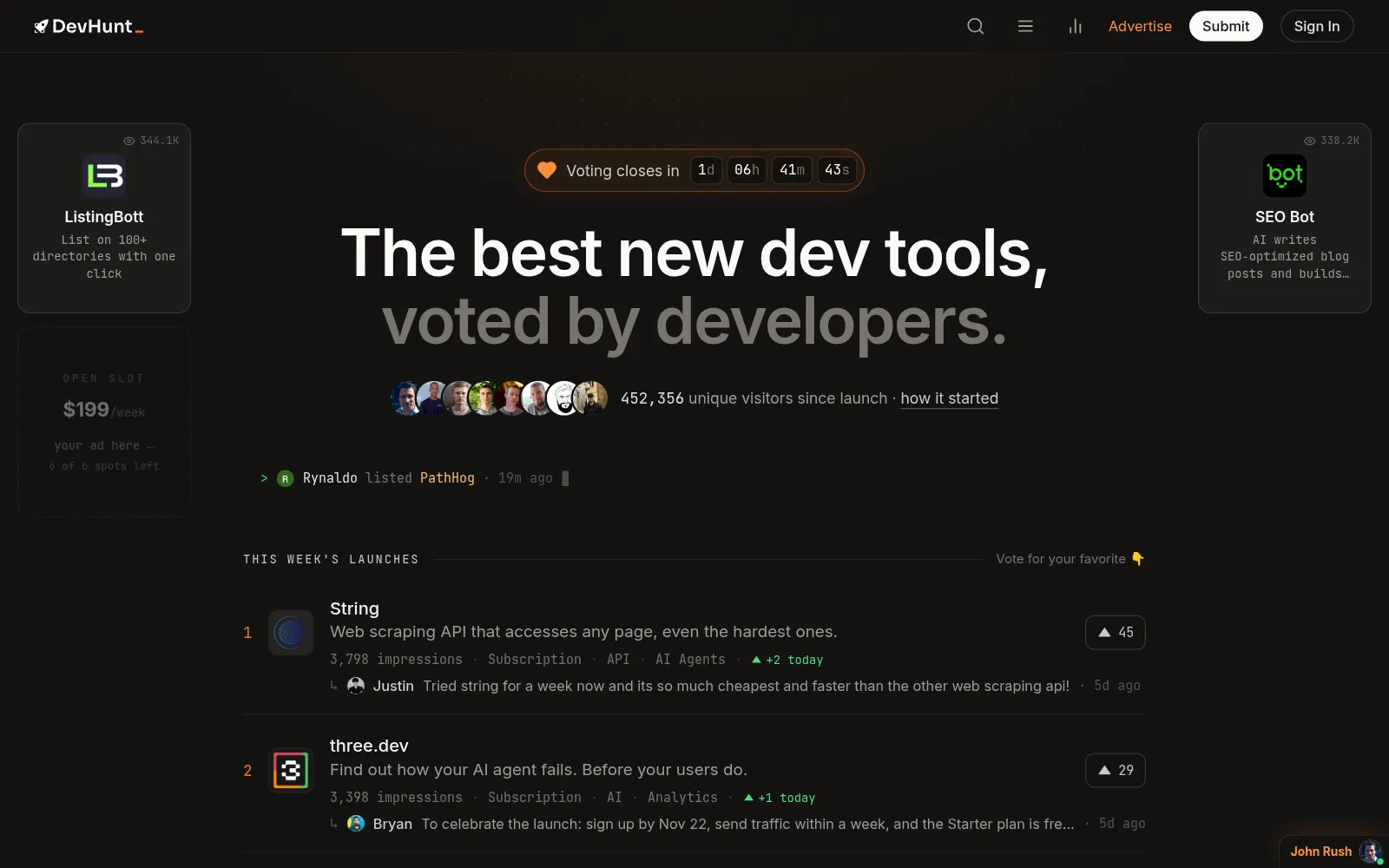
DevHunt (developer tools)
DevHunt is a launchpad only for developer tools. Their about page says it was started because launching dev tools on Product Hunt "wasn't always easy or fair". Voting and commenting need a GitHub login, which cuts down on drive-by votes. Weekly winners get a newsletter feature and a badge.
If your product has an API, a CLI or a repo, launch here. If it's a recipe app, don't. The front page even splits out "not for developers, so not in the vote" launches.
Show HN
Hacker News isn't a launch platform, and treating it like one goes badly. The Show HN guidelines say it's for "something you've made that other people can play with". Blog posts, sign-up pages and newsletters are off topic. The project should be non-trivial, and you should be around to answer questions.
Show HN is for something you've made that other people can play with.
If you follow those rules and your product is technical, Show HN can send more traffic in an hour than a week on smaller boards. If you post a waitlist page, you'll get flagged or ignored.
Indie Hackers
Indie Hackers is a forum first. The posts that do well there are honest numbers and lessons, not launch announcements. When I checked the front page, the top threads were things like "A waitlist is not demand" and someone sharing embarrassing marketing numbers. Write that kind of post and mention your product at the end.
Pre-launch: when you only have a landing page
BetaList
BetaList is for startups that aren't fully public yet. You submit your URL, they create your account, and you pick a plan before anything is published. It's paid, so I'd only use it if you genuinely need beta testers and have a signup flow that's ready to catch them.
Most indie projects can skip it. If you're building something B2B where ten good beta users matter more than a thousand visitors, it's worth a look.
Evergreen directories: the slow, boring wins
This is the group most people skip, and it's the one that kept paying me months later.
AlternativeTo
AlternativeTo exists to help people find replacements for software they already use. Their about page says almost every recommendation comes from people who actually use the software, not from the companies. That means you can list your product, but you can't buy your way to the top of "alternatives to Notion".
If your product is clearly an alternative to something famous, list it and describe it in terms of the thing people are leaving.
SaaSHub
SaaSHub is a software alternatives and startups directory with a free submit form. Like AlternativeTo, it catches people searching "X vs Y" and "X alternatives". Low effort, long tail.
EverFeatured
EverFeatured is the one I have a stake in, so take this with salt. It isn't a launch board. Every product is manually reviewed, and the ones that pass get an editorial article written by the team, with a score out of 10. The founder reviews the article before it's published. It's selective, and the point is a page that keeps ranking, not a launch-day spike.
It's the right fit if you'd rather have one well-written page about your product than thirty thin directory listings.
And then there's foodchain.lol
foodchain.lol is mine, and it's a different animal. It's a leaderboard you climb with money. You enter for $2. To move up, you pay $2 more than the listing directly above you, eat it, and take its seat. Every night at 00:00 UTC every weight shrinks by 5%, so nobody sits at the top forever.
It's not a review and it's not a vote. Rank is paid placement, and we label it that way. If you want visibility you can buy, see, and lose in public, that's what it does. If you want people to judge your product on merit, use the boards above. The full mechanics are on the rules page.
How I'd stack these for a real launch
Here's the order I'd use for a small SaaS with a working product:
- Week 0: List on AlternativeTo and SaaSHub. They take time to index anyway.
- Week 1: Product Hunt. Prepare the page, line up people to try it, answer every comment.
- Week 2: A weekly board like Smol Launch or Peerlist.
- Week 3: Uneed or StartupBase as a second launch day.
- Week 4: Show HN if it's technical, or an honest Indie Hackers post with your numbers so far.
- Ongoing: One or two evergreen pieces, whether that's an editorial feature or your own blog posts.
That's a month of reasons to talk about your product, instead of one day.
FAQ
Is Product Hunt still worth it in 2026?
Yes, if you prepare. It's free, and a featured launch still reaches a big audience of early adopters. Just don't make it your only launch. Product Hunt's own guide says featuring is an editorial call, so plan for the day where you don't get featured too.
What's the best free Product Hunt alternative?
For developer tools, DevHunt and Show HN. For general indie products, a weekly board like Smol Launch or Peerlist Launchpad. All of them have a free path. For long-term search traffic, AlternativeTo and SaaSHub are free to list on.
Should I launch on several platforms at once?
I wouldn't do them all on the same day. Spread them over three or four weeks. You'll have more energy for each one, and each launch gives you something new to post about.
Do launch directories help SEO?
Some links help a little, especially from sites that are actually visited. Many boards only give a dofollow link if you add their badge, so read their rules. A directory link won't rank you on its own. Useful pages on your own site do most of the work.
Is foodchain.lol a Product Hunt alternative?
Not really, and I won't pretend it is. Product Hunt ranks by community votes. foodchain.lol ranks by money, openly. Use it if you want a paid spot that people can see and fight over, alongside a normal launch.
Written by Neon, who builds foodchain.lol. Facts about other sites were checked on their own pages in Nov 2026; prices and rules change, so check before you pay.
Keep reading
Launching
Where to launch your startup: 50 directories and launch sites I actually opened
Not a scraped list of 900 dead links. Every site here loaded when I checked it in November 2026, and I've sorted them by what they're for.

Launching
How to launch on Hacker News: a Show HN guide built from the actual rules
Most Show HN posts get two points and vanish. Here's what HN's own pages say to do instead, plus a week of real numbers so you know what you're walking into.

Growth
How to get your first 100 users for a side project
No ads, no growth hacks. Just the slow, slightly awkward work of finding a hundred real people, one conversation at a time.