How to get your first 100 users for a side project
No ads, no growth hacks. Just the slow, slightly awkward work of finding a hundred real people, one conversation at a time.
The first hundred users are the hardest ones you'll ever get. After that you have word of mouth, a few reviews, maybe a blog post that ranks. Before that you have a URL and a lot of hope.
I'm in the middle of this right now with foodchain.lol, so this isn't a victory lap. It's the plan I'm following, the reasoning behind each step, and the sources I trust. Where I quote someone, I've linked the original.
The short version: pick one kind of person, go to where they already are, and talk to them one at a time. Everything else is detail.
Step 1: Describe one user, not a market
"Developers" is not a user. "Freelancers" is not a user. You can't search for them, you can't find their forum, and you can't write a sentence that makes them stop scrolling.
Try finishing this sentence:
My project helps [a specific person] do [a specific job] without [a specific pain].
For foodchain.lol, mine is: it helps indie makers who just launched get seen without waiting for a daily leaderboard to pick them. That's narrow, and it tells me exactly where to look: launch boards, build-in-public threads, maker communities.
If you can't write that sentence yet, you don't have a distribution problem. You have a research problem. Fix that first.
Step 2: Find where they already hang out
Make a list of ten places your person already spends time. Be concrete. Not "Reddit" but the two subreddits. Not "Discord" but the specific server.
- Subreddits and forums about their job or their tools
- Discord and Slack groups
- Newsletters they read
- Launch boards and directories they browse
- Accounts they follow on X or LinkedIn
Then cut the list to two or three. You don't have the time to show up properly in ten places, and showing up badly is worse than not showing up.
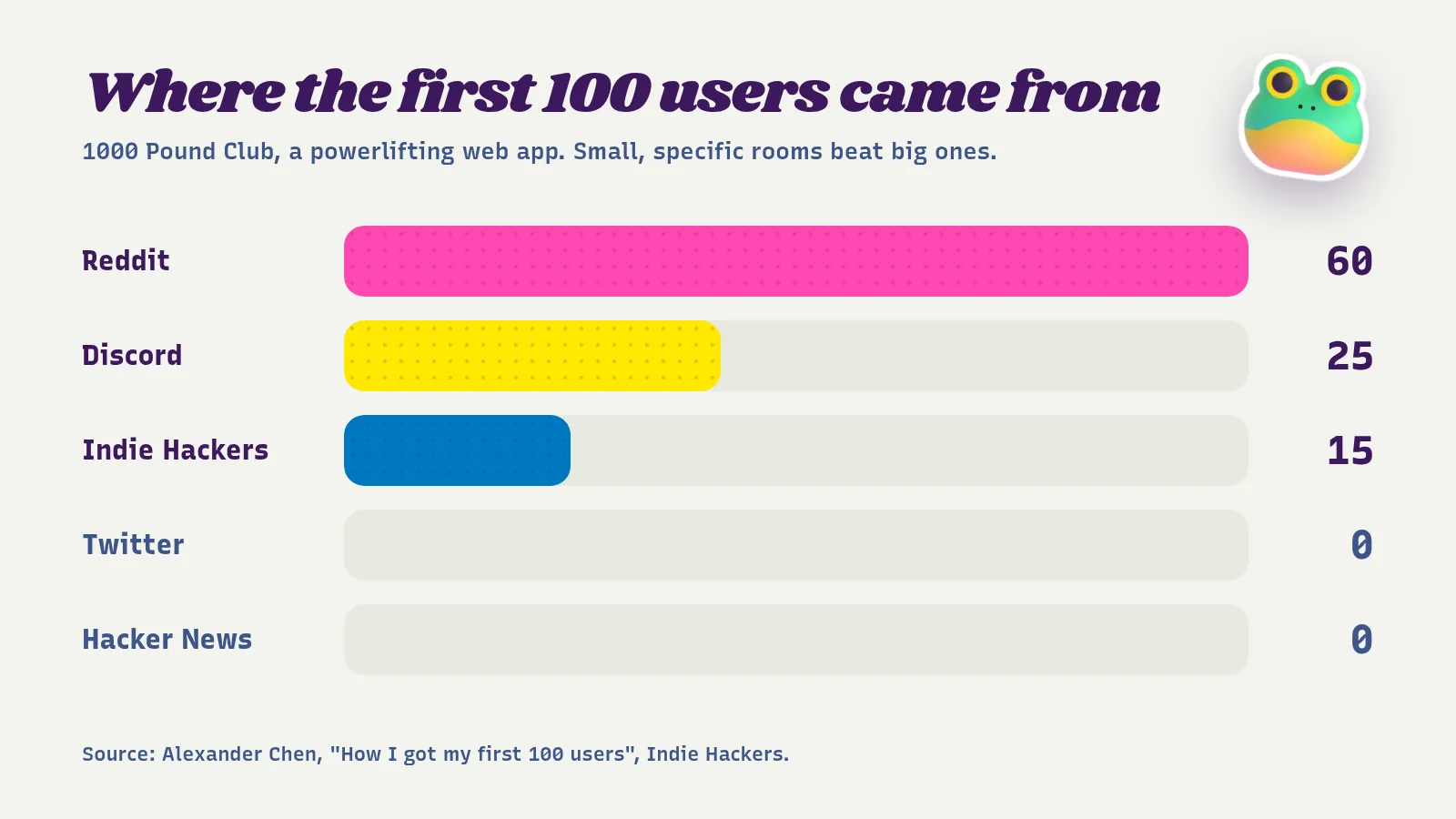
Here's a real example of why fit matters more than size. Alexander Chen wrote up how he got his first 100 users for a powerlifting web app called 1000 Pound Club. His breakdown:
| Channel | Users |
|---|---|
| 60 | |
| Discord | 25 |
| Indie Hackers | 15 |
| 0 | |
| Hacker News | 0 |
Hacker News, the giant, sent nothing. His explanation was simple: even if a thousand people saw it there, almost none of them were into powerlifting. The small, specific rooms won.
Step 3: Recruit the first twenty by hand
This is the step everyone skips, because it's uncomfortable and it doesn't feel like it scales. It doesn't. That's the point.
Paul Graham's essay Do Things that Don't Scale is still the best thing written on this:
The most common unscalable thing founders have to do at the start is to recruit users manually. Nearly all startups have to.
He tells the story of the "Collison installation". When someone agreed to try Stripe, the Collison brothers didn't say "great, we'll send you a link". They said "right then, give me your laptop" and set them up on the spot.
For a side project, that looks like:
- Search for the problem, not the product. Find posts where people describe the exact pain you solve. Reply with something useful first.
- Offer to set it up for them. A 15-minute call where you watch someone use your thing will teach you more than a week of analytics.
- Keep a dumb spreadsheet. Name, where you found them, date, what they said, did they sign up. That's your whole CRM.
Step 4: Build in public, but share the real stuff
Building in public works when you share things people can learn from: what broke, what you tried, what the numbers actually are. It doesn't work when every post is "so excited to announce".
I've been posting daily updates on foodchain.lol as I build it: how the payments work, what security issues I found in my own code before launch, why the board digests 5% every night. The posts that get the most replies are never the announcements. They're the ones where I explain a decision or admit a mistake.
A few habits that help:
- Post one small, true thing a day. A screenshot, a number, a lesson.
- Ask for something specific. I asked people to comment with their product so I could feature five of them free at launch. That's a reason to reply, not just to like.
- Reply to everyone in the first few weeks. Those people are your first users.
Step 5: Launch in the right rooms, and more than once
Launch day is a spike, not a strategy. But spikes help, especially if you stack a few of them over a month.
I've written separate guides on this, so here's the short version:
- One big launch on Product Hunt, properly prepared.
- A weekly board a week later, like Smol Launch or Peerlist Launchpad.
- A niche board that matches your product, like DevHunt for dev tools.
- Show HN, only if people can try it right away. Its guidelines say sign-up pages and blog posts are off topic.
- A handful of evergreen directories that people browse when they search. My checked list is in where to launch your startup.
Each of these is also a reason to post an update, which feeds Step 4.
If you want a bit of paid visibility on top, pay-to-rank boards are an option. That's what I built foodchain.lol for: you can claim a spot for $2, and climb by eating the listing above you. It's labelled as paid placement, and it's not a substitute for steps one to four. I compared the whole category in outbid.lol alternatives.
Step 6: Keep the ones you get
Getting a hundred sign-ups is easy compared to keeping them. A few things I'm doing:
- Email every new user personally for the first hundred. One line: "Hey, I'm Neon, I built this. What made you sign up?"
- Ship their requests fast. Alexander Chen noticed the same thing: users were impressed when he shipped a requested feature within an hour or so.
- Watch where people drop off. If half your sign-ups never finish onboarding, fix that before you go find more people.
Things that feel productive but aren't
I've done all of these. They felt like progress at the time.
Polishing the landing page for another week. Nobody has seen it yet. A rough page in front of twenty people teaches you more than a perfect page in front of none.
Posting the same link in ten communities on the same day. It reads as spam because it is spam. Moderators notice, and so do the people you wanted to reach.
Chasing a big account to share it. Sometimes it happens, mostly it doesn't, and either way you can't plan around it.
Building features nobody asked for. If you don't have users, you don't have requests, so every new feature is a guess. Ship the smallest thing that solves the one problem from Step 1, then listen.
Watching analytics all day. With twelve visitors, the dashboard can't tell you anything a conversation can't tell you better.
The common thread: they're all ways of avoiding the uncomfortable part, which is asking a stranger to try your thing.
A 30-day plan you can copy
Put together, this is the plan I'd hand a friend:
| Week | Focus | Daily habit |
|---|---|---|
| 1 | Write the one-sentence user. List ten places. Cut to three. | Read those communities for 20 minutes |
| 2 | Recruit by hand. Aim for twenty people. | Five personal messages a day |
| 3 | Launch on one big board and one niche board. | Reply to every comment, post one update |
| 4 | Second launch, evergreen directories, one useful blog post. | Email every new user personally |
It's not clever. It works because most people don't do it consistently for 30 days.
FAQ
How long does it take to get 100 users?
It depends on the product and how much time you put in. Some makers get there in a launch week. Most take one to three months of steady work. Spending time on distribution every day matters more than any single channel.
Should I use paid ads for my first 100 users?
Usually not. You don't know yet who your user is or what message works, so you'd be paying to learn things you can learn for free by talking to people. Ads make more sense once you know your conversion rate.
Is Product Hunt enough to get 100 users?
Sometimes, if you're featured and well prepared. But Product Hunt decides who gets featured, so don't rely on it. Stack it with a niche board, a community post and personal outreach.
What if my product is niche?
That's an advantage early on. Niche communities are easier to find and more likely to care. The 1000 Pound Club example got 60 of its first 100 users from Reddit and none from Hacker News, because the powerlifters were on Reddit.
Does building in public really help?
It helps when you share useful, honest updates and talk to the people who reply. It doesn't help if every post is an announcement. Treat it as a way to meet your first users, not a way to go viral.
Written by Neon, who builds foodchain.lol. Facts about other sites were checked on their own pages in Nov 2026; prices and rules change, so check before you pay.
Keep reading
Launching
How to launch on Hacker News: a Show HN guide built from the actual rules
Most Show HN posts get two points and vanish. Here's what HN's own pages say to do instead, plus a week of real numbers so you know what you're walking into.
Launching
Best Product Hunt alternatives to launch your startup in 2026
Product Hunt gives you one loud day. These are the places I'd use for the other 364, grouped by what they're actually good at.
Launching
Where to launch your startup: 50 directories and launch sites I actually opened
Not a scraped list of 900 dead links. Every site here loaded when I checked it in November 2026, and I've sorted them by what they're for.